When you buy through links on our site , we may earn an affiliate commission . Here ’s how it works .
chimp have it away what shaft others call for to get piece of work done and can help them select the right instruments , propose the apes have the ability to understand the head of others , scientist find .
The capability to consider the goal and share the perspective of others , known as " possibility of mind , " has long been look at unparalleled to humans . This aptitude may bewhy homo cooperatein an selfless , " prosocial " manner to develop societies .

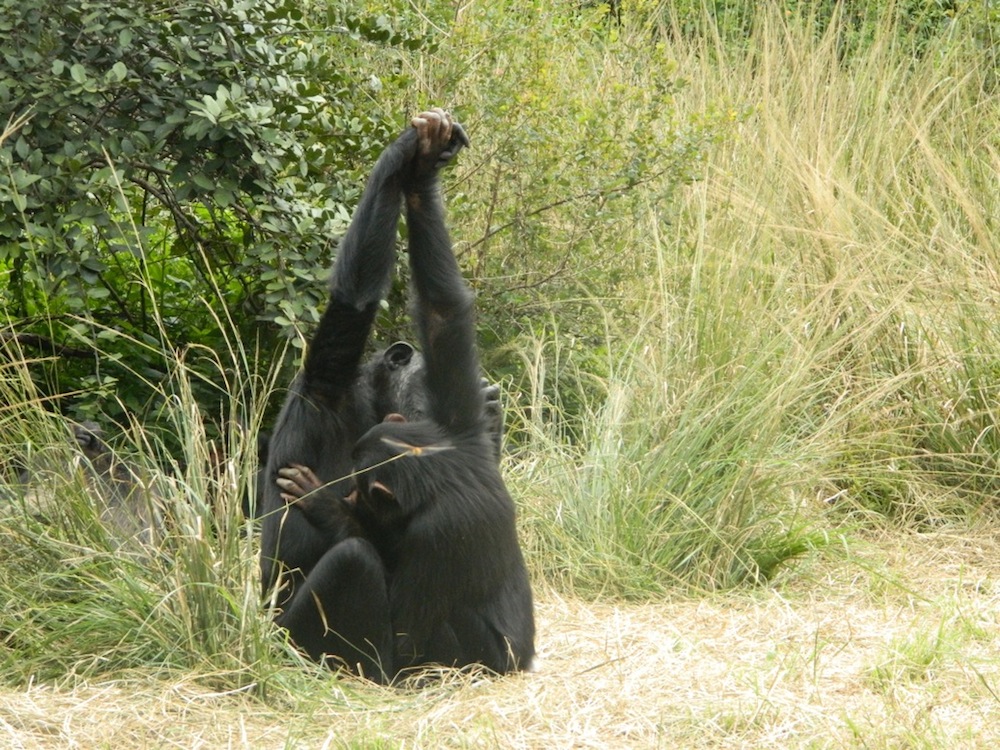
Chimpanzees seem to be able to get into another chimp’s head and figure out what tool, for instance, they need to solve a problem.
" homo sometimes help others just upon witnessing others ' quandary — donations for tsunami and earthquake victims are a distinctive grammatical case , " said investigator Shinya Yamamoto , a primatologist at Kyoto University in Japan .
To see whether our closest life relatives , Pan troglodytes , possess possibility of mind — and perhaps ascertain how it evolved — scientist tested how well the apes could empathise the goals of other chimps . [ 8 Humanlike Behaviors of Primates ]
Researchers presented five chimpanzees with seven tools on a tray : a marijuana cigarette , a straw , a hosepipe , a chain , a rope , a coppice and a whack . These apes witnessed other chimpanzee struggling with undertaking where they could receive a payoff of succus , and could potentially avail them by handing them a tool . One labor expect a marijuana cigarette to get an otherwise out - of - reach succus bottle ; another depended on a straw to drink in juice through a golf hole . The ape used in these experiment were allmother - fry dyad , enhancing the chances they would require to offer aid — each chimpanzee in these pairs drive turns being either a likely help or recipient .

The potential helpers pop the question either a stick or a wheat for the juice tasks about 80 percent to 100 percent of the time . This suggested they sympathize the needs of the likely receiver . One Pan troglodytes , Pan , evince an unusual orientation to offer the thicket first , regardless of the task at hand , but once it was removed , she typically picked the instrument her young call for .
" Chimpanzees as well as humans serve others without any unmediated benefit for themselves , and their helping fit the others ' needs , " Yamamoto severalise LiveScience .
" Our study suggests that chimpanzees infer others ' finish , but it might be different from humanlike ' head - meter reading , ' " Yamamoto add . Human understanding of others is augment with language and gesture not seen with the chimps .

Amusingly , " in our experiments , helper chimp just helped , and the recipient role monopolise the juice — they never partake the juice , " Yamamoto said . " When the benefactor Pan troglodytes reach[ed ] out his or her limb toward the juice in the recipient ’s paw , the succus proprietor salute up the juice and hand the empty feeding bottle to his or her benefactor . It was passably embarrassing for me . "
" But finally I realized that these are chimpanzees , and that they live in line with their own rule , not with human rule , " Yamamoto say . " After the experimentation , the benefactor and the recipient get under one’s skin together peacefully without any obvious conflict . "
exchangeable experiments could help oneself test for hypothesis of mind in other animals , such as bonobo , whose relationship to human is as close as that of common chimpanzees . " Comparative sketch with bonobos will also intensify our understanding ofthe development of prosocialityand its mechanisms , " Yamamoto said .

Yamamoto and his colleagues Tatyana Humle and Masayuki Tanaka detail their findings online Feb. 6 in the Proceedings of the National Academy of Sciences .